Timely stroke treatment at Mercy Hospital St. Louis prevents lasting harm


Mercy Hospital St. Louis was able to quickly diagnose and treat Maplewood Fire Department Chief Peter Marsac for an ischemic stroke, preventing any lasting damage.
Mercy Hospital St. Louis was able to quickly diagnose and treat Maplewood Fire Department Chief Peter Marsac for an ischemic stroke, preventing any lasting damage.
They’re a tricky silhouette at first glance—kinda boxy, kinda wide. But once you figure out the secret to wearing them…..they’re a HELL-YES! Cropped wide leg jeans are chic, current, and super versatile.
Vice President Kamala Harris has secured the Democratic presidential nomination, but has yet to choose a running mate, with interviews scheduled for this weekend.
L.A. residents can reduce their reliance on cars by walking, biking, or taking public transit, which not only helps the environment but also saves money and can make traveling more.

L.A. may be the city of the car, but it doesn’t have to be.
Whether you’re looking to cut back on your emissions, or want to connect with your neighborhood on a deeper level — or your soul simply can’t handle another rush hour on the 405 — there are a LOTof reasons to ditch the ol’ automobile.
Cities built for carless travel are safer, greener, and make transportation more efficient. They make getting around cheaper, too.
But the automobile is hardwired into L.A.’s DNA. Our city is literally built around cars — neighborhoods were leveled to make way for freeways, historic buildings were demolished to build surface parking lots.

Stimson Building, on South Spring Street and West 3rd Street, before and after it was demolished and turned into a parking lot in 1963.
And it’s not just city infrastructure. We drive to school, we drive to work. We drive to the gym, to the beach, to grandma’s house, the grocery store. How do you part with something that’s so embedded in your daily routine?
Before we get into the tips and tricks, I’ll share a bit of my own car-free journey. I wasn’t born with a love for public transit — far from it.
I’m a born-and-raised Angeleno who started driving when I was 17. My first regular commute was a 45-minute slog across three freeways to get from home to high school — and I never once imagined living in L.A. without a car.
A decade or so later when the lease was up on my car in 2021, I decided I may as well try to save some cash and give the car-free life a try. We made a How To LA episode about that process, and my new commute to work, which you can check out here.
But the moral of that episode is: you don’t need to ditch your car completely, tomorrow, in order to get the benefits of going car-free.
Maybe you can’t give up your car for various reasons — that’s totally fine! It’s so expensive to live in L.A. that many people have to live far from where they work. Or maybe you love your 1995 Subaru too much to part with it. I get it.
The goal isn’t to get rid of CARS; it’s to get rid of car-DEPENDENCY. This guide is meant to make that transition a tiny bit easier.
Change is easiest when change is fun. If going cold turkey is more your speed, skip to Step 5. But if you’re like me, you’ll need a little more convincing before alternative transit in Los Angeles sounds exciting.
Step 1: Find foot-friendly destinations
Find a cafe, bar, or restaurant within walking distance of your home, and make a habit of walking there. Show it off to your friends and brag that you have such a great spot within such a quick walk. If you don’t have anything like that within say a mile of your home, make it a park or a library.
The idea is to train yourself to expect that walking can be exciting and productive. For your first goal, try to go to this spot at least two or three times per week.

Step 2: Shop local, shop often
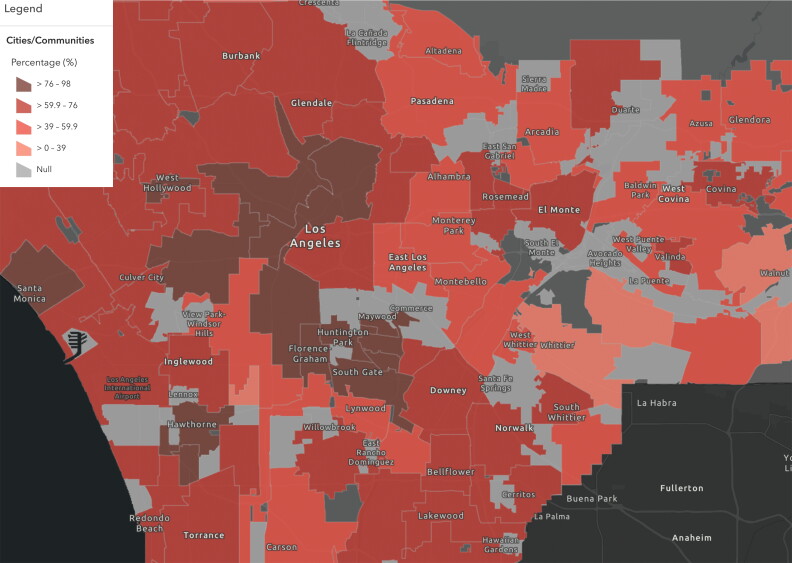
Most residents in L.A. County live within a mile of their nearest grocery store. In places like West Hollywood, South Gate, Hawthorne, or Echo Park, that number is above 76%. In the valley, Inglewood and Downey, that number is still nearly 60%.
Even in areas known as food deserts like Lynwood or East L.A., at least 39% of residents live within walking distance of a grocery store.
Your closest market might be a lot closer than you think. Of course, not everyone can get around on foot or bicycle, or carry things long distance. But if you’re able to do so, take advantage! Though counterintuitive, it’s been proven to be cheaper and healthier to buy what you need the day you need it, and avoid shopping in bulk.
For your second goal, try buying what you need for dinner after work every day for a week. Breaking routines takes practice and repetition — but it helps when it tastes great and saves you money!
By now you’ve fallen in love with a spot that’s walking distance from your home, and you’ve bragged about it to your friends. Maybe you’re still buying your groceries every day or every other day. Nice!
It’s time to start experimenting with your routines.
Step 3: Discover new modes of transit
L.A. has a subway — a fact I’m not ashamed to say took 26 years of living here for me to internalize. We also have the third largest bus fleet in North America, and our flat, wide streets are excellent for bicycling.
Let’s be realistic: none of these are perfect. Bus service can be infrequent, the subway and light rail network has limited connectivity, and the safety of our bike lanes (where they exist) leaves a lot to be desired.
And we have have to be honest about safety concerns on LA Metro. Reports of violent crime last year increased about 14% over pre-pandemic levels. After the stabbing death of a woman at a Metro train stop in Studio City, the Metro Board of Directors declared a state of emergency to step up safety measures, including barriers for bus drivers.
All of this is unsettling and worth considering, depending on where you live, what time of day you’ll be riding and your comfort level. And it’s also worth framing these safety concerns within the context of the dangers posed by cars.
That all said, from my almost-daily experience riding either the train, my bike or the bus, I’d argue at least one of these alternative modes of transit is a better experience than you may expect.

Step 4: Identify your loops
This step is easier written than done, but it’s time to modify your routine. Most of our travel is recurring. To and from work, to and from the gym, or to and from a family member’s house.
Identify one of these loops and travel it via public transit, biking, or walking. Then do it again so you get comfortable with the idea.
Then do it again, and again.
By now you could lead a walking tour of your neighborhood, and you have a bike or have your TAP card on your phone. You’ve taken the bus for either work or play, and you’ve probably beat your car-driving peers to the destination at least a handful of times.
If that’s you, it might be time to take the final plunge.
Step 5: Sell your dang car
It’s finally time. The moment we’ve been building to all along. Maybe you, like the average Angeleno, have two cars in your household. Or maybe you, like me, finished the lease on your car and want to try out a bike before taking on another expensive lease.
Either way, it’s go time.
Selling your car is actually pretty easy. Apps like Carvana and CarMax give decently competitive prices, and people use Craigslist all the time. As a last resort you can probably sell your car back to your dealer, but that’s usually the least profitable option — especially if you have an end-of-lease purchase option.
(You could also donate your car to LAist to power local journalism!)
When the lease on my Honda Civic ended in 2021, I was able to sell it for about $9,000 more than the end-of-lease purchase price. After DMV fees and taxes, that meant a profit of about $7,000.
(Now that pandemic-level supply chain issues are easing, you might not be able to replicate those numbers. But experts still recommend taking advantage of end-of-lease purchases when possible.)
I purchased my bike for $300, and after a tune-up, some new handlebars, and two years of TAP card payments for my metro fare, I still have over $6,000 left over.
Add that to the savings of NOT having a car payment, not paying for gas or insurance, and I’ve saved a little over $15,000 in 18 months of living car-free.
Going car-free is L.A.’s greenest transit option, but that alone isn’t always the strongest motivator. But it’s also great for your wallet, and studies show there’s psychological and economic benefits for people and cities.
If you’re not ready to go all the way and ditch your car for good, that’s OK! But maybe, as you and other Angelenos around you start weaving alternative modes of transit into your life, a less car congested city can become a reality for all of us.
The number of houses destroyed in the Alexander Mountain Fire grew by two as
officials announced the wildfire west of Loveland was 100% contained.
Saturday’s news release by the Roosevelt National Forest showed a total of 28
houses and 21 outbuildings were destroyed. The last reported number of houses
lost in the fire was 26, according to fire officials. The number of outbuildings
destroyed remained the same.
All destroyed structures occurred in the Cedar Park area.
The final number of acres burned remained at 9,668.
Firefighters will continue to monitor the area and Burned Area Emergency
Response (BAER) work continues to assess the damage to the landscape, according
to the news release.
More: First look behind the fire lineTour behind Alexander Mountain Fire lines
reveals both total destruction and spared homes
Here is the timeline of the Alexander Mountain Fire and how it compares to other
notable Larimer County wildfires:
ALEXANDER MOUNTAIN FIRE TIMELINE
“The Forest wants to recognize both the hard work as well as the stress and
difficulty of the past three weeks,” Acting Forest Supervisor Jason Sieg stated
in the news release. “There are members of the Cedar Park community who lost
property and homes, and we will support them as best we can alongside our
community partners and local agencies. As we move into the recovery phase of the
work, we look forward to continuing to work together, and we know the work is
not over.”
HOW THE ALEXANDER MOUNTAIN FIRE COMPARES TO OTHER NOTABLE LARIMER COUNTY
WILDFIRES
Alexander Mountain Fire
Cameron Peak Fire
High Park Fire
Bobcat Gulch Fire
LARIMER COUNTY OFFERS $1,000 TO OFFSET BUILDING PERMIT
Larimer County will soon initiate a disaster rebuild program for the Alexander
Mountain Fire that will include some tools for people whose homes were impacted
by the fire.
The rebuild program would include a maximum $1,000 reduction on the building
permit fee for people who want to rebuild the homes damaged by the wildfire (and
up to $500 for outbuildings).
The program would be similar to what the county has done after previous
wildfires.
See the full story here.
To reach the Larimer County’s Fire Recovery Line, call 970-980-2800 or check the
county’s Alexander Mountain Fire Recovery website for additional information.
ALEXANDER MOUNTAIN FIRE HUMAN CAUSED. HERE’S HOW YOU CAN HELP IN THE
INVESTIGATION
Investigators are still accepting information regarding the wildfire that
officials determined was human caused.
Anyone with information about the potential cause or origin of the fire can call
the U.S. Forest Service Law Enforcement Tip Line at 303-275-5266. Photos and
videos that may help with this investigation can be submitted via the U.S.
Forest Service website.
Coloradoan reporter Ignacio Calderon contributed to this report.
The man accused of sparking the nearly 10,000-acre Alexander Mountain Fire in
Larimer County acted as a “self-proclaimed fire manager” and wanted to be seen
as “the hero,” according to court documents obtained by Denver7 Friday.
LARIMER COUNTY, Colo. — The man accused of sparking the nearly 10,000-acre
Alexander Mountain Fire in Larimer County acted as a “self-proclaimed fire
manager” and wanted to be seen as “the hero,” according to court documents
obtained by Denver7 Friday.
The fire sparked on July 29 near Drake north of Highway 34 and burned 9,668
acres over about three weeks. On Aug. 9, the U.S. Forest Service confirmed that
the fire was human-caused, but no other specifics were available at the time.
Officials had previously referenced signs of human activity near where the fire
apparently started.
More than 5,000 people evacuated, but no injuries were reported. However, the
fire destroyed about 29 homes and 21 outbuildings and damaged four additional
homes. The firefight cost an estimated $11 million, while the fire damage was
estimated to be more than $30 million, according to court documents.
During a press conference on Sept. 11, the Larimer County Sheriff’s Office and
the U.S. Forest Service identified Jason Alexander Hobby, 49, of Loveland as a
suspect in the fire. He faces charges of first-degree arson, two counts of
impersonating a peace officer, felony menacing, false imprisonment and
impersonating a public servant. He was taken into custody on Sept. 10 and issued
a $450,000 cash/surety bond.
Hobby was an employee at the Sylvan Dale Guest Ranch — a family-owned,
3,200-acre property in the foothills west of Loveland — until he was identified
as a suspect during the course of the investigation, said Larimer County Sheriff
John Feyen during the press conference. The ranch then terminated his
employment.
Watch the full press conference below:
Full press conference: Arrest in Alexander Mountain Fire investigation
According to court documents, investigators determined that the fire originated
from a three-feet by three-feet makeshift rock fire pit located 1.4 miles away
from a residence adjacent to the Sylvan Dale Guest Ranch. There were three wood
logs — two to the west and one to the south — located near the fire pit.
Investigators also found foil lids for yogurt containers, containers of yogurt
and a sardine can inside the pit, court documents state.
The affidavit says the fire burned for “a period of time” before reports started
coming into the sheriff’s office.
Investigators determined that someone tried to “suppress or extinguish fire in
the origin area.” They spotted “debris, foliage and grass that was pulled away
from trees to prevent those trees from burning,” according to court documents.
The affidavit says there were also fresh cuts made to trees using a chainsaw.
Authorities noticed a person’s boot footprints that were “haphazardly” scattered
throughout the origin area. Investigators determined that the footprints
belonged to a man’s size 12 boot with Vibram soles.
Denver7
During the investigation, authorities interviewed several employees of the
Sylvan Dale Guest Ranch. Many fingered Hobby as a potential suspect, according
to court documents. He reportedly was the “self-proclaimed fire manager” of the
ranch and lived at a home close to the origin of the fire.
The affidavit says Hobby was disciplined by the ranch owners on July 23 for
“conducting unauthorized armed (firearm) law enforcement duties on the property,
by wearing a uniform with law enforcement “Ranger” insignia, and operating
several vehicles with a “Ranger” star on the door.” He allegedly had a history
of “aggressively” confronting people about trespassing.
Hobby reportedly told the ranch owners that he was a firefighter in Wyoming and
allegedly said he traveled to the state on his off days to help fight fires. The
affidavit says Hobby owned a marked fire department vehicle — a white Ford
pickup truck with emergency lights and equipment. The truck had “Twin Butte Fire
Protection” in blue lettering on the doors, as well as “Brush-236” and “Fire.”
Affidavit: Man suspected of sparking Alexander Mountain Fire wanted to be seen
as ‘the hero’
Hobby allegedly told the ranch manager that he was going to be in Douglas,
Wyoming, on July 29 — the day the fire started. However, the affidavit says the
manager saw Hobby on the ranch less than 90 minutes after the initial reported
start of the fire. He was allegedly with another unknown person wearing
“firefighting Nome uniforms.” The affidavit explains that Nomex is a “fire
retardant/ resistant fabric commonly used by professional firefighters to
protect them from catching fire.”
Staff at the ranch told the manager they heard firearms being fired near
Alexander Mountain before the fire sparked, according to the affidavit.
Authorities executed a search warrant at Hobby’s home on Aug. 7. According to
the affidavit, deputies seized several items during the search, including:
The same day his home was searched, Hobby consented to an interview. He told
investigators he was not in Colorado when the fire started and was working as a
firefighter in Manville, Wyoming, on July 28 and July 29, according to the
affidavit. However, the court document says Hobby was in Manville working on a
truck that had broken down.
According to the affidavit, a friend of Hobby’s drove him to Manville on July
28, which is about 3.5 hours north of Loveland. Investigators obtained
surveillance video reportedly showing Hobby at a Napa Auto Parts Store in Lusk,
Wyoming, on July 29. He was seen leaving the store just before 8 a.m., according
to court documents.
Investigators asked Hobby to take a polygraph examination. The court document
says Hobby was asked if he started the Alexander Mountain Fire, and he said no.
The polygraph examiner reported that Hobby failed the exam and was untruthful
during that question, according to the affidavit.
Local
ALEXANDER MOUNTAIN FIRE BURNS SITE FOR SUICIDE PREVENTION NONPROFIT
9:30 PM, Aug 06, 2024
The affidavit references an interview with a manager of the Heart-J Center, a
nonprofit that helps people connect with nature. The Heart-J Center has operated
from the Sylvan Dale Guest Ranch for the past decade, and the family who owns
the ranch plans to one day transfer the ranch to the nonprofit’s management.
The manager told investigators they were “concerned that Hobby created this
incident to insert himself as the hero in the eyes of staff after his recent
disciplinary work history,” according to the affidavit. The manager said the
property owners had compiled a “lengthy list of infractions” reportedly
committed by Hobby over the past two years. The list included allegations of
bullying and harassment, as well as incidents involving a firearm, court
documents state.
The manager recalled that one of the ranch owners asked Hobby to be the “ranch
security officer” in the summer of 2022. Hobby allegedly began wearing a uniform
and driving a “personally owned vehicle with indicators of “Sylvan Dale Ranger”
with emergency lights equipped.” He also began conducting traffic stops using
his personal vehicle, according to the manager.
The ranch owners demoted Hobby from his security duties in July 2024, the
affidavit states. After he was demoted, Hobby reportedly told fellow staff
members that he felt “persecuted and ganged up on.”
Hobby was also allegedly against the ranch being transferred to the Heart-J
Center. He reportedly “expressed anger, hatred, and fear of the plans for the
land to go to the Heart-J Center.” The affidavit says Hobby told another
employee, “Things would be better if the Heart-J Center exploded.” About 1,240
acres of the Sylvan Dale Ranch that was to be donated to the nonprofit was
burned in the Alexander Mountain Fire, according to court documents.
At one point, the Heart-J Center partnered with the Loveland Fire Rescue
Authority to burn “slash piles” in the Cedar Park area. Hobby was allegedly
upset that he was “not included in these discussions being the self-proclaimed
Fire Manager of the property.” Due to the interference, the nonprofit canceled
its plans, and the piles were not burned, according to the manager.
As the Alexander Mountain Fire burned, Hobby allegedly entered evacuated and
restricted areas of the ranch and gave staff “updates as to the damage and the
direction of the fire’s travels.”
The affidavit discusses a meeting that was held at the fire incident command
post on July 30. Hobby and several Heart-J Center employees were reportedly in
attendance. During that meeting, Hobby said he knew how the fire started and
claimed it was from an unattended campfire on Alexander Mountain, according to
court documents. However, the affidavit says investigators did not determine the
cause of the fire until Aug. 3.
Denver7 | Gives
HOW TO HELP BOULDER, JEFFERSON AND LARIMER COUNTY WILDFIRE VICTIMS
2:08 PM, Aug 02, 2024
During their investigation, authorities talked with two brothers who traveled to
Sylvan Dale Guest Ranch to photograph big horn sheep on March 23. One brother
told investigators they went to the ranch’s front office and spoke to employees,
who gave them permission to be on the property.
According to the affidavit, the two entered the property on the dirt roads to
the southwest side of the property. They mistakenly ended up on a canal access
road, which did not have signage and was not barricaded, the court document
states.
The affidavit says the two got out of their vehicle and started to gather their
camera equipment when they spotted a white Chevrolet Tahoe with flashing lights
“speed up to them at a very quick speed.”
According to the brothers, a man wearing a uniform “resembling a law enforcement
officer” got out of the vehicle and pointed a handgun at them. He reportedly
said the brothers were under arrest for trespassing. After a few moments, the
man “changed his behavior, deescalated and offered to take them to a different
part of the ranch where they would have a better view of the sheep.” The
brothers said the man guided them to a different portion of the ranch and “then
joked with them, acting as if he was issuing them a citation.”
The brothers provided pictures of the man, and investigators identified him as
Hobby, according to court documents. They also sent photos of the vehicle, which
had “decals similar to the Larimer County Sheriff’s Office badge or the Larimer
County Department of Natural Resources “Park Rangers” badge affixed to the
doors,” the affidavit states.
Denver7
Investigators also obtained a video that Hobby had allegedly sent from inside
the Alexander Mountain Fire area to several employees from the Heart-J Center
and Sylvan Dale Guest Ranch. In the video, Hobby is reportedly seen at the top
of Storm Mountain on the ranch, which was a restricted area at the time. He was
allegedly wearing a wildland fire uniform and a helmet that had a Twin Buttes
Fire Protection and Wildland Management emblem.
In the video, Hobby allegedly said he responded to the area “to fight the fire,
and that the real firefighters were staging outside the area.” The affidavit
says Hobby “appeared in his statement to be upset that firefighters were not in
that area fighting the fire.”
According to the court documents, investigators spotted a cabin building that
was “very remote and approximately 1/2 mile from the nearest access point to the
property and the residential area of Sylvan Dale Ranch” as well as a yellow fuel
can in the video.
Authorities went to the cabin on Aug. 23 and spotted “what appeared to be drip
can activity” as well as burn areas that indicated “someone tried to start a
back burn or fire mitigation around the cabin,” according to the affidavit.
Someone also allegedly used a chainsaw to cut bushes and shrubs away from the
cabin.
The affidavit says a yellow can that contained a “reddish fuel” was found in the
same spot that was seen in the video.
Denver7 Investigates
RECORDS DETAIL CRIMINAL RECORD LINKED TO ALEXANDER MOUNTAIN FIRE SUSPECT
9:50 PM, Sep 12, 2024
Investigators looked into Hobby’s claim that he was a firefighter in Wyoming.
The affidavit explains people interested in becoming a wildland firefighter must
attend training and obtain a “Red Card.” Firefighters must then carry that card
when working and present it when asked, according to the court document.
The affidavit says Hobby was not issued a Red Card. Investigators also learned
that a man “resembling Hobby” had shown up to fires in Natrona County, Wyoming,
and worked with crews but left without being paid for his work, according to
court documents.
Three Wyoming counties — Natrona, Converse and Platte — did not have a record of
Hobby or his business, Twin Buttes Fire Protection, according to court
documents. The affidavit says the Wyoming State Forestry also did not have a
record of Hobby being a certified firefighter or wildland firefighter.
During their investigation, authorities dug into Hobby’s criminal history.
Following his arrest, Denver7 Investigates obtained court records from Riverside
County, California, where Hobby had previously faced criminal charges. The
records revealed Hobby was arrested on July 4, 1999.
According to the court documents, Hobby was arrested for not having “private
security” patches. He was eventually charged with manufacturing, importing, and
selling weapons, failing to carry valid security ID, and wearing a baton without
registering it.
All charges were dismissed due to a violation of the defendant’s rights to a
speedy trial, according to a spokesperson for the Riverside County District
Attorney’s Office.
Hobby’s arrest affidavit lists his criminal history as follows:
Hobby does not have a criminal history in Colorado or Wyoming, according to his
affidavit.
Watch our previous Denver7 Investigates coverage in the video player below:
Records detail criminal record linked to man arrested in connection to Alexander
Mountain Fire
Coloradans making a difference | Denver7 featured videos
Denver7 is committed to making a difference in our community by standing up for
what’s right, listening, lending a helping hand and following through on
promises. See that work in action, in the videos above.
Copyright 2024 Scripps Media, Inc. All rights reserved. This material may not be
published, broadcast, rewritten, or redistributed.
THE MORNING HEADLINES, SIGN UP FOR A MIX OF WHAT YOU NEED TO KNOW TO START THE
DAY IN COLORADO, PICKED FOR YOU.
Original Reporting This article contains firsthand information gathered by
reporters. This includes directly interviewing sources and analyzing primary
source documents.
Investigators have determined that the Alexander Mountain fire, which has burned
nearly 10,000 acres in northern Colorado and destroyed 51 structures, was
human-caused.
The fire was sparked July 29 west of Loveland in Larimer County. As of Friday,
it had burned 9,669 acres and was 91% contained.
The fire destroyed 26 homes and damaged at least four others, according to a
report by the Larimer County Assessor. Twenty-one outbuildings were also
destroyed.
U.S. Forest Service wildland investigators are working with the Larimer County
Sheriff’s Office to chase clues on who may have started the fire, even if it
wasn’t intentionally.
Investigators are asking anyone with information about the start of the fire to
call the Forest Service’s tip line at 303-275-5266. Photos, videos and typed
statements can also be uploaded online.
They are interested in information about anyone who was in the area immediately
east and below the peak of Alexander Mountain, photos of the fire between 10:30
a.m. and 11:15 a.m. July 29 and information from anyone who spends time in the
Alexander Mountain area.
Alexander Mountain was one of three Front Range wildfires that officials have
determined were human-caused and ignited the last week of July, before rain
brought much-needed relief to extremely dry conditions.
Arson investigators are still looking into the cause of the Quarry fire, which
grew to nearly 580 acres in a highly-populated area of Jefferson County before
firefighters got the perimeter fully under control earlier this week.
On Saturday, officials from the Larimer County Sheriff’s Office and the Forest
Service made their way to where they believed the fire started. Sheriff John
Feyen said it was a “hard hike to get in there,” and that’s when they started
their forensic investigation. They know the origin of the fire and that it was
human-caused, but have not released further information on the investigation.
Federal investigators are also looking into the Stone Canyon fire that destroyed
five structures and is linked to one death in Boulder County.
The cause of the fire is still unknown, but the involvement of the Alcohol,
Tobacco, Firearms and Explosives, alongside Boulder County officials, indicates
that authorities suspect it was human-caused.
☀️ READ MORE
TYPE OF STORY: NEWS
Based on facts, either observed and verified directly by the reporter, or
reported and verified from knowledgeable sources.
Olivia Prentzel covers breaking news and a wide range of other important issues
impacting Coloradans for The Colorado Sun, where she has been a staff writer
since 2021. At The Sun, she has covered wildfires, criminal justice, the
environment,…
The man accused of sparking the nearly 10,000-acre Alexander Mountain Fire in
Larimer County acted as a “self-proclaimed fire manager” and wanted to be seen
as “the hero,” according to court documents obtained by Denver7 Friday.
LARIMER COUNTY, Colo. — The man accused of sparking the nearly 10,000-acre
Alexander Mountain Fire in Larimer County acted as a “self-proclaimed fire
manager” and wanted to be seen as “the hero,” according to court documents
obtained by Denver7 Friday.
The fire sparked on July 29 near Drake north of Highway 34 and burned 9,668
acres over about three weeks. On Aug. 9, the U.S. Forest Service confirmed that
the fire was human-caused, but no other specifics were available at the time.
Officials had previously referenced signs of human activity near where the fire
apparently started.
More than 5,000 people evacuated, but no injuries were reported. However, the
fire destroyed about 29 homes and 21 outbuildings and damaged four additional
homes. The firefight cost an estimated $11 million, while the fire damage was
estimated to be more than $30 million, according to court documents.
During a press conference on Sept. 11, the Larimer County Sheriff’s Office and
the U.S. Forest Service identified Jason Alexander Hobby, 49, of Loveland as a
suspect in the fire. He faces charges of first-degree arson, two counts of
impersonating a peace officer, felony menacing, false imprisonment and
impersonating a public servant. He was taken into custody on Sept. 10 and issued
a $450,000 cash/surety bond.
Hobby was an employee at the Sylvan Dale Guest Ranch — a family-owned,
3,200-acre property in the foothills west of Loveland — until he was identified
as a suspect during the course of the investigation, said Larimer County Sheriff
John Feyen during the press conference. The ranch then terminated his
employment.
Watch the full press conference below:
Full press conference: Arrest in Alexander Mountain Fire investigation
According to court documents, investigators determined that the fire originated
from a three-feet by three-feet makeshift rock fire pit located 1.4 miles away
from a residence adjacent to the Sylvan Dale Guest Ranch. There were three wood
logs — two to the west and one to the south — located near the fire pit.
Investigators also found foil lids for yogurt containers, containers of yogurt
and a sardine can inside the pit, court documents state.
The affidavit says the fire burned for “a period of time” before reports started
coming into the sheriff’s office.
Investigators determined that someone tried to “suppress or extinguish fire in
the origin area.” They spotted “debris, foliage and grass that was pulled away
from trees to prevent those trees from burning,” according to court documents.
The affidavit says there were also fresh cuts made to trees using a chainsaw.
Authorities noticed a person’s boot footprints that were “haphazardly” scattered
throughout the origin area. Investigators determined that the footprints
belonged to a man’s size 12 boot with Vibram soles.
Denver7
During the investigation, authorities interviewed several employees of the
Sylvan Dale Guest Ranch. Many fingered Hobby as a potential suspect, according
to court documents. He reportedly was the “self-proclaimed fire manager” of the
ranch and lived at a home close to the origin of the fire.
The affidavit says Hobby was disciplined by the ranch owners on July 23 for
“conducting unauthorized armed (firearm) law enforcement duties on the property,
by wearing a uniform with law enforcement “Ranger” insignia, and operating
several vehicles with a “Ranger” star on the door.” He allegedly had a history
of “aggressively” confronting people about trespassing.
Hobby reportedly told the ranch owners that he was a firefighter in Wyoming and
allegedly said he traveled to the state on his off days to help fight fires. The
affidavit says Hobby owned a marked fire department vehicle — a white Ford
pickup truck with emergency lights and equipment. The truck had “Twin Butte Fire
Protection” in blue lettering on the doors, as well as “Brush-236” and “Fire.”
Affidavit: Man suspected of sparking Alexander Mountain Fire wanted to be seen
as ‘the hero’
Hobby allegedly told the ranch manager that he was going to be in Douglas,
Wyoming, on July 29 — the day the fire started. However, the affidavit says the
manager saw Hobby on the ranch less than 90 minutes after the initial reported
start of the fire. He was allegedly with another unknown person wearing
“firefighting Nome uniforms.” The affidavit explains that Nomex is a “fire
retardant/ resistant fabric commonly used by professional firefighters to
protect them from catching fire.”
Staff at the ranch told the manager they heard firearms being fired near
Alexander Mountain before the fire sparked, according to the affidavit.
Authorities executed a search warrant at Hobby’s home on Aug. 7. According to
the affidavit, deputies seized several items during the search, including:
The same day his home was searched, Hobby consented to an interview. He told
investigators he was not in Colorado when the fire started and was working as a
firefighter in Manville, Wyoming, on July 28 and July 29, according to the
affidavit. However, the court document says Hobby was in Manville working on a
truck that had broken down.
According to the affidavit, a friend of Hobby’s drove him to Manville on July
28, which is about 3.5 hours north of Loveland. Investigators obtained
surveillance video reportedly showing Hobby at a Napa Auto Parts Store in Lusk,
Wyoming, on July 29. He was seen leaving the store just before 8 a.m., according
to court documents.
Investigators asked Hobby to take a polygraph examination. The court document
says Hobby was asked if he started the Alexander Mountain Fire, and he said no.
The polygraph examiner reported that Hobby failed the exam and was untruthful
during that question, according to the affidavit.
Local
ALEXANDER MOUNTAIN FIRE BURNS SITE FOR SUICIDE PREVENTION NONPROFIT
The affidavit references an interview with a manager of the Heart-J Center, a
nonprofit that helps people connect with nature. The Heart-J Center has operated
from the Sylvan Dale Guest Ranch for the past decade, and the family who owns
the ranch plans to one day transfer the ranch to the nonprofit’s management.
The manager told investigators they were “concerned that Hobby created this
incident to insert himself as the hero in the eyes of staff after his recent
disciplinary work history,” according to the affidavit. The manager said the
property owners had compiled a “lengthy list of infractions” reportedly
committed by Hobby over the past two years. The list included allegations of
bullying and harassment, as well as incidents involving a firearm, court
documents state.
The manager recalled that one of the ranch owners asked Hobby to be the “ranch
security officer” in the summer of 2022. Hobby allegedly began wearing a uniform
and driving a “personally owned vehicle with indicators of “Sylvan Dale Ranger”
with emergency lights equipped.” He also began conducting traffic stops using
his personal vehicle, according to the manager.
The ranch owners demoted Hobby from his security duties in July 2024, the
affidavit states. After he was demoted, Hobby reportedly told fellow staff
members that he felt “persecuted and ganged up on.”
Hobby was also allegedly against the ranch being transferred to the Heart-J
Center. He reportedly “expressed anger, hatred, and fear of the plans for the
land to go to the Heart-J Center.” The affidavit says Hobby told another
employee, “Things would be better if the Heart-J Center exploded.” About 1,240
acres of the Sylvan Dale Ranch that was to be donated to the nonprofit was
burned in the Alexander Mountain Fire, according to court documents.
At one point, the Heart-J Center partnered with the Loveland Fire Rescue
Authority to burn “slash piles” in the Cedar Park area. Hobby was allegedly
upset that he was “not included in these discussions being the self-proclaimed
Fire Manager of the property.” Due to the interference, the nonprofit canceled
its plans, and the piles were not burned, according to the manager.
As the Alexander Mountain Fire burned, Hobby allegedly entered evacuated and
restricted areas of the ranch and gave staff “updates as to the damage and the
direction of the fire’s travels.”
The affidavit discusses a meeting that was held at the fire incident command
post on July 30. Hobby and several Heart-J Center employees were reportedly in
attendance. During that meeting, Hobby said he knew how the fire started and
claimed it was from an unattended campfire on Alexander Mountain, according to
court documents. However, the affidavit says investigators did not determine the
cause of the fire until Aug. 3.
Denver7 | Gives
HOW TO HELP BOULDER, JEFFERSON AND LARIMER COUNTY WILDFIRE VICTIMS
During their investigation, authorities talked with two brothers who traveled to
Sylvan Dale Guest Ranch to photograph big horn sheep on March 23. One brother
told investigators they went to the ranch’s front office and spoke to employees,
who gave them permission to be on the property.
According to the affidavit, the two entered the property on the dirt roads to
the southwest side of the property. They mistakenly ended up on a canal access
road, which did not have signage and was not barricaded, the court document
states.
The affidavit says the two got out of their vehicle and started to gather their
camera equipment when they spotted a white Chevrolet Tahoe with flashing lights
“speed up to them at a very quick speed.”
According to the brothers, a man wearing a uniform “resembling a law enforcement
officer” got out of the vehicle and pointed a handgun at them. He reportedly
said the brothers were under arrest for trespassing. After a few moments, the
man “changed his behavior, deescalated and offered to take them to a different
part of the ranch where they would have a better view of the sheep.” The
brothers said the man guided them to a different portion of the ranch and “then
joked with them, acting as if he was issuing them a citation.”
The brothers provided pictures of the man, and investigators identified him as
Hobby, according to court documents. They also sent photos of the vehicle, which
had “decals similar to the Larimer County Sheriff’s Office badge or the Larimer
County Department of Natural Resources “Park Rangers” badge affixed to the
doors,” the affidavit states.
Denver7
Investigators also obtained a video that Hobby had allegedly sent from inside
the Alexander Mountain Fire area to several employees from the Heart-J Center
and Sylvan Dale Guest Ranch. In the video, Hobby is reportedly seen at the top
of Storm Mountain on the ranch, which was a restricted area at the time. He was
allegedly wearing a wildland fire uniform and a helmet that had a Twin Buttes
Fire Protection and Wildland Management emblem.
In the video, Hobby allegedly said he responded to the area “to fight the fire,
and that the real firefighters were staging outside the area.” The affidavit
says Hobby “appeared in his statement to be upset that firefighters were not in
that area fighting the fire.”
According to the court documents, investigators spotted a cabin building that
was “very remote and approximately 1/2 mile from the nearest access point to the
property and the residential area of Sylvan Dale Ranch” as well as a yellow fuel
can in the video.
Authorities went to the cabin on Aug. 23 and spotted “what appeared to be drip
can activity” as well as burn areas that indicated “someone tried to start a
back burn or fire mitigation around the cabin,” according to the affidavit.
Someone also allegedly used a chainsaw to cut bushes and shrubs away from the
cabin.
The affidavit says a yellow can that contained a “reddish fuel” was found in the
same spot that was seen in the video.
Denver7 Investigates
RECORDS DETAIL CRIMINAL RECORD LINKED TO ALEXANDER MOUNTAIN FIRE SUSPECT
Investigators looked into Hobby’s claim that he was a firefighter in Wyoming.
The affidavit explains people interested in becoming a wildland firefighter must
attend training and obtain a “Red Card.” Firefighters must then carry that card
when working and present it when asked, according to the court document.
The affidavit says Hobby was not issued a Red Card. Investigators also learned
that a man “resembling Hobby” had shown up to fires in Natrona County, Wyoming,
and worked with crews but left without being paid for his work, according to
court documents.
Three Wyoming counties — Natrona, Converse and Platte — did not have a record of
Hobby or his business, Twin Buttes Fire Protection, according to court
documents. The affidavit says the Wyoming State Forestry also did not have a
record of Hobby being a certified firefighter or wildland firefighter.
During their investigation, authorities dug into Hobby’s criminal history.
Following his arrest, Denver7 Investigates obtained court records from Riverside
County, California, where Hobby had previously faced criminal charges. The
records revealed Hobby was arrested on July 4, 1999.
According to the court documents, Hobby was arrested for not having “private
security” patches. He was eventually charged with manufacturing, importing, and
selling weapons, failing to carry valid security ID, and wearing a baton without
registering it.
All charges were dismissed due to a violation of the defendant’s rights to a
speedy trial, according to a spokesperson for the Riverside County District
Attorney’s Office.
Hobby’s arrest affidavit lists his criminal history as follows:
Hobby does not have a criminal history in Colorado or Wyoming, according to his
affidavit.
Watch our previous Denver7 Investigates coverage in the video player below:
Records detail criminal record linked to man arrested in connection to Alexander
Mountain Fire
Coloradans making a difference | Denver7 featured videos
Denver7 is committed to making a difference in our community by standing up for
what’s right, listening, lending a helping hand and following through on
promises. See that work in action, in the videos above.
Copyright 2024 Scripps Media, Inc. All rights reserved. This material may not be
published, broadcast, rewritten, or redistributed.
THE MORNING HEADLINES, SIGN UP FOR A MIX OF WHAT YOU NEED TO KNOW TO START THE
DAY IN COLORADO, PICKED FOR YOU.
GRAND JUNCTION, Colo. (KKCO) – Former Mesa County Clerk and Recorder Tina Peters
received her sentencing on October 3 after being found guilty of seven of the 10
charges she faced on August 12.
The trial followed allegations that Peters had tampered with voting machines and
caused a security breach during the 2020 election.
The trial focused on two main accusations: authorization to access voting
machines and identity theft.
During the trial, the prosecution argued that Peters did not have legal
authorization during the time the supposed tampering took place.
The defense argued Peters was to determine the validity of the election and
events, saying the act was not illegal at the time.
Sherrona Bishop, a political activist and one of Peter’s supporters said she
worked on campaigns for the City Council and municipal elections, and “when the
election was over, it didn’t seem right to me or to many in the community.”
For the identity theft accusations, the prosecution argued that Peters broke
rule 20.3.1 under the Secretary of State’s guidelines for election officials,
which speaks to who can be in the room where voting equipment is housed.
“We don’t want to give a key to the room to somebody who hasn’t passed a
criminal background check and who is an employee,” said Caleb Thornton, legal
policy and rule-making manager for the Colorado Secretary of State. “They need
to be an employee. You can’t just give it to anybody. It’s got to be an employee
who passes a criminal background check.”
Furthermore, they argued that Peters allowed Conan Hayes, a former pro-surfer,
to enter the room under the identity of Gerald Wood, a private sector software
engineer of Mesa County. The defense said this was not a violation of her duties
as the clerk.
Ultimately, Peters was found guilty on such charges as:
The trial made national headlines.
“I know that it was going to take a huge person to be nervy enough to say ‘we
need to see what’s happening inside of the Dominion voting machines,” said
Debbie Caroll, a Littleton resident and Tina Peters supporter.
“Ultimately, we cannot allow a person, especially someone like Tina Peters, who
was elected to oversee and execute Mesa County’s elections, to compromise
Colorado’s election equipment or election protocol,” said Jena Griswold,
Colorado Secretary of State.
View all of our past coverage of the Tina Peters Trial.
Copyright 2024 KKCO. All rights reserved.
