(TP1) Tina Peters’ 9-year prison sentence marks a pivotal moment for election security

Tina Peters is headed to prison. 

The former Mesa County Clerk was sentenced to nine years of incarceration, most
of which will be served in the Colorado Department of Corrections. 

Peters’ attorneys indicated they plan to appeal.

21st Judicial District Judge Matthew Barrett preceded his sentence with a
blistering critique of her actions and attitude, calling Peters an
attention-seeking former official who only thinks about herself. 

“You are no hero,” Barrett told Peters. “You’re a charlatan who used, and is
still using, your prior position in office to peddle a snake oil that’s been
proven to be junk time and time again.” 

Barrett handed down the sentence in front of a packed courtroom that included
supporters of Peters, several uniformed sheriff’s deputies and local elected
officials. An overflow crowd gathered just outside the courtroom, streaming the
proceedings on their phones from feet away. 

In August, Peters was found guilty by a jury of Mesa County residents on seven
counts, including four felonies, after she helped facilitate unauthorized access
to county voting equipment that she was supposed to safeguard in search of voter
fraud. Her supporters have never shown that the machines were involved in any
sort of election manipulation.

During Thursday’s hearing, the prosecution argued that Peters should face the
maximum penalty for most, if not all, of the charges. 

“I don’t think anybody in this room would make a straight-faced argument that
Mrs. Peters has demonstrated any respect for the law,” 21st Judicial District
Attorney Dan Rubinstein said. He noted that she continues to argue she never did
anything wrong.

“Ms. Peters has made this community a joke. She’s made respecting law
enforcement a joke, made respecting court orders a joke. She’s not accepted any
responsibility and considers this a badge of honor,” said Rubinstein.

Courtesy of Larry Robinson/The Grand Junction Daily Sentinel

Ahead of sentencing, Peters asked for probation. She said she recognized the
jury’s decision to find her guilty on most of the counts, but that the jury
wasn’t allowed to hear other evidence she wanted to present. That evidence was
largely tied to conspiracies about the county’s Dominion Voting Machines, which
were ruled inadmissible. 

“I’m not a criminal and I don’t deserve to go into a prison where other people
have committed heinous crimes,” Peters told the judge tearfully. She showed the
judge pictures of her deceased husband and her son, a Navy Seal who died in the
line of duty. She asked for probation in part to be able to keep visiting her
95-year-old mother in Virginia. 

“I’m remorseful. Yes sir, I really am,” said Peters. “I never expected that just
doing an image which was completely legal, before and after the trusted build
would’ve landed me here. I thought it was going to come out quietly.”

But Barrett said his sentence was not just about punishment and the acceptance
of responsibility but also deterrence. A stiff sentence, Barrett said, would
ensure other elected officials respect the responsibilities of their office. 

“I’m convinced you would do it all over again if you could,” Barrett said.
“You’re as defiant a defendant as this court has ever seen.”  

IMPACT STATEMENTS PRESENT DUELING VIEWS OF PETERS

The prosecution and defense were each given an hour to make their case ahead of
Barrett’s sentencing decision. 

Mesa County Commissioner Cody Davis said the estimated cost of Peters’ actions
to Mesa County taxpayers was $1.4 million. That includes Peters’s salary while
she was barred from the elections office, as well as numerous recounts the
county paid for to prove their elections were accurate. 

While Davis explained the efforts to convince the public that Peters’ claims
were untrue, Barrett interjected to ask what the hand count and other recounts
showed. 

“I want to know, what was the difference?” Barrett asked. 

“They were identical,” Davis said, of the votes,  noting that a hand count as
well as a tabulation by a different voting machine company confirmed the
election tallies were accurate. “No material difference.” 

“No material difference whatsoever,” Barrett echoed. 

Davis also said Peters’ damage to the county went beyond the budget, to its
broader reputation.

“People from across Colorado and other states now associate Mesa County, not
with our natural beauty or agriculture, but with the infamous actions of Ms.
Peters. Her behavior has made this county a national laughing stock,
overshadowing our accomplishments and our values,” Davis concluded.

Tom Hesse/CPR News

Former Republican Mesa County Commissioner Scott McInnis called for Peters to
face the consequences of her actions; he referred to her as a disgrace and said
all of her allegations of fraudulent votes amount to nothing. 

“They have never produced not one fraudulent vote, your Honor, not one
fraudulent vote in Mesa County. Despite all these allegations, despite all these
studies,” said McInnis.

Peters’ defense presented character witnesses from her life, one who spoke
tearfully about her as a friend and a gold-star mother who lost her son in a
military accident.

“She is not a threat to the community, she’s not a threat to the state,” said
California pastor Dave Bryan, who asked Barrett not to sentence Peters to prison
time, but instead to order her to serve probation at his church in California.
“She’s never been a threat to any other human being and (a prison sentence)
could only smack of political vindication.” 

Former Republican Elbert County Clerk Dallas Schroeder also testified in support
of Peters; he implored the judge not to incarcerate her for “searching for the
truth.” 

“That is tyranny at its worst when people are afraid to be able to stand up and
say what they truly believe and to investigate things,” said Shroeder. Schroeder
was sued by the state over copies he made of Elbert County’s election machine
hard drives around the same time as Peters.

Screenshot from KREX livestream

Barrett questioned Schroeder on why Peters needed to do more than audit and
count the ballots.

“You want to evaluate it in a clearer way than actually going back and looking
at what the machine told you the results were and then counting the ballots
yourself?” Barrett asked. 

Schroeder said it still makes sense for clerks to have the opportunity to see
everything that’s going on within the elections system. 

THE SENTENCE IS THE CULMINATION OF A MULTI-YEAR INVESTIGATION AND LEGAL FIGHT

Peters was found guilty of three felony counts of attempting to influence a
public servant and one count of conspiracy to commit criminal impersonation. She
was also convicted of first-degree official misconduct, violation of duty, and
failure to comply with an order from the Secretary of State, all misdemeanors.

The investigation began a little more than three years ago when images taken
during a secure update of Mesa County’s voting equipment surfaced online. At the
same time, a copy of Mesa County’s hard drive was displayed and discussed at a
“cyber symposium” hosted by Mike Lindell, the MyPillow CEO who has been at the
center of false claims that the 2020 presidential election was stolen.

Kevin J. Beaty/Denverite

Over the course of a lengthy trial, prosecutors laid out a timeline
demonstrating that Peters had begun meeting with election conspiracy theorists
in early 2021 about assumed “irregularities” in voting totals. In response,
Peters and others hatched a plan to bring in an unauthorized person to observe a
software update of Dominion Voting Machines. The plot involved creating security
credentials for a local man named Gerald Wood and using those credentials to
help another man gain access to voting equipment. 

That man was retired surfer Conan Hayes, who clandestinely joined the software
update and made copies of sensitive information that ended up online. That
deceit was what the jury found Peters guilty of. 

Editor’s Note: An earlier version of this story incorrectly described Scott
McInnis as a former Mesa County Clerk. He’s a former county commissioner who was
in office at the time the election security breach came to light.

Now that you can return home after the fires, how do you clean up safely?

A drone image of the aftermath of the Palisades fire

By Karen Garcia

 and Tony Briscoe

Jan. 17, 2025 2:37 PM PT

  • Health experts suggest you wait before returning to an evacuation zone to check on your fire-damaged home.
  • If you plan to visit a burn zone, take precautions such as wearing gloves, an N95 mask, a long-sleeved shirt and sturdy shoes.

Now that authorities are allowing residents to return to fire evacuation zones to see what’s left of their homes, health experts say it’s safer to wait a while before venturing into the burn areas.

But if you plan on seeing with your own eyes what has become of your home, there are some precautions you can take to protect your health.

Los Angeles County officials gave the word this week that as many as 11,000 people will be able to return to their homes.

But authorities are still concerned about residents coming into contact with the hazardous materials that have been left behind by the unprecedented blaze.

Earlier this week, California Gov. Gavin Newsom signed executive orders aimed at expediting recovery, emphasizing the importance of removing hazardous waste from the burn scars to ensure safe recovery.

On Wednesday, the Los Angeles County Department of Public Health issued an order prohibiting the cleanup or removal of fire debris at fire-damaged and burned properties in critical fire areas, including the areas of the Palisades, Eaton, Kenneth, Creek, Hurst and Lidia fires, until a hazardous materials inspection is completed by an approved government agency.

Federal and state environmental agencies are preparing to survey fire-ravaged properties.

“We understand completely that people are anxious to get back onto their property,” said Yana Garcia, California Environmental Protection Agency secretary. “But I cannot emphasize enough how important it is to have hazardous waste removed by trained personnel with protective equipment.”

Hazards in the area can include “things like batteries, ammunition, propane tanks, pesticides, even household cleaning products that can become extremely volatile and toxic when exposed to heat and fire,” Garcia said.

Among those who have lost their home to the Palisades fire is Dr. Ashraf M. Elsayegh, a pulmonologist with Providence Saint John’s Health Center, who hasn’t returned to his residence to assess the damage and isn’t in a hurry to do so.

During a news conference at the hospital on Thursday, Elsayegh said his family will eventually want to go back to their home to see if anything is salvageable, he said.

“I think I’m going to wait as long as possible and if I do go, I will use all the proper precautions,” Elsayegh said.

The doctor expressed serious caution about returning to the fire zone because of the harmful chemicals that are in the ash that is coating the damaged and remaining homes.

Researchers still don’t completely understand the scope of just how harmful urban fire ash is in the immediate area and its effect on surrounding communities.

What experts do know is that urban fires are more toxic than wildfires because of the chemicals emanating from burned homes, items inside the homes and cars.

Part of the reason behind the lack of available data is because “we have nothing to compare it to [because the Los Angeles-area fires are] a combination of wildfire as well as urban fire,” which poses different risks than a wildfire alone, he said.

Elsayegh described the Los Angeles-area fires as “the largest urban fire in modern United States history.”

The only somewhat comparable urban fire incident Elsayegh could point to was the Sept. 11, 2001, attack on New York’s World Trade Center, which he was present for.

In the months that followed the 9/11 attack, first responders and residents were exposed to a hazardous mix of asbestos, silica dust, heavy metals and other dangerous chemicals left behind by the massive amounts of ash, dust and debris created when the towers collapsed.

“If we learned anything [from Sept. 11, it is that] we probably went back too soon,” he said.

Experts don’t have an exact timeline of when people should head back to burn areas; their main advice is to listen to local authorities.

“Which is easier said than done because we’re all going to want to rebuild at some point,” Elsayegh said.

What harmful chemicals are in the immediate area of burned homes

When you are allowed back into a once-evacuated area, experts warn that you should wear protective gear.

“The ash lives for about two years in any particular area, so it’s going to be around for a while,” Elsayegh said.

The ash contains volatile organic compounds that can include benzene, silica, asbestos, lead, hydrogen cyanide and hydrogen fluoride. A majority of these compounds are carcinogens.

These compounds come from older burning homes, cars, furniture and even cleaning products inside the home, he said.

If you’re returning to a burn area to survey the damage or digging through the rubble for family heirlooms, for example, you’re exposing yourself to the harmful chemicals.

These toxins can affect your heart, bloodstream and even gastrointestinal tract, Elsayegh said.

“We’ve seen before that after large wildfires, we have asthma exacerbations, chronic obstructive pulmonary disorder, emphysema, bronchitis, pneumonia and lung infections,” he said.

Long-term health effects can include lung cancer, pulmonary fibrosis or silicosis.

Elsayegh again points to the World Trade Center and said “about 20% to 25% of all of the people exposed to the [9/11 plume of smoke and ash] are still requiring medical care for their lungs.”

How to protect yourself when assessing your residence

Before you enter any burn site, Elsayegh recommends you get a tetanus shot.

There’s going to be a lot of metal and possibly rusted nails in these areas and if you get a cut, there’s a high risk for a tetanus infection.

You can make an appointment for a tetanus shot at the following locations:

The tetanus booster shot is recommended every 10 years. If you haven’t had a booster, Elsayegh recommends you get one.

The protective gear to wear when visiting a burn site should include:

  • An N95 mask. Cloth, surgical and bandannas allow too much air in and don’t filter out finer particles.
  • Protective eye wear such as googles, not glasses.
  • Work gloves.
  • A long-sleeved shirt and pants.
  • Sturdy shoes with thick soles.

Once you’re done visiting a burn area and you return to your temporary lodging, remove all your clothes and protective gear outside before you enter the residence to reduce exposing others inside the home.

You’re dealing with potential asbestos compounds in the ash, and after being exposed to them, they can cling to your clothes and skin.

If any part of your skin was exposed to the ash during your visit, Elsayegh said to use baby wipes to clean it off and then immediately take a shower.

My home was saved. How can I clean it?

If there is ash collected outside of your home, experts suggest you not sweep it or use a leaf blower because you can blow it back up into the air.

Instead, mist the ash with water, gather it into a trash bag and throw it away in your trash bin.

Do not use a garden hose to soak the ash because you’ll just create a toxic sludge.

When you’re able to return to your home that wasn’t damaged by the fires, the inside of the home will have ash particles.

Do not sweep, dust or use a regular vacuum to clean up the ash particles. Instead, use a vacuum with a HEPA filter to clear away small particles left in the home, Pasadena city officials advise.

They advised that commercial cleaning may be needed for carpet, upholstery and window treatments.

Who shouldn’t be a part of cleanup efforts?

Children, pregnant women and those with asthma, chronic obstructive pulmonary disease, chronic heart disease or diabetes should avoid cleaning up fire damage or ash.

Symptoms to look out for and where to get help

If you are visiting a burn area or have been volunteering in affected communities, experts say you should look out for symptoms of exposure such as upper respiratory tract infections, asthma exacerbation, shortness of breath and allergic-type reactions.

If you aren’t feeling well, call your doctor for further consultation.

You can also call Providence Saint John’s Health Center’s newly established disaster relief pulmonary clinic for a consultation at (310) 829-8618.

Deputy features editor Marques Harper contributed to this report.

Some residents allowed to return to devastated Pacific Palisades, Altadena neighborhoods

Rows of houses are in rubble after fire tore through Pacific Palisades.

By Hannah Fry

Sandra McDonaldAndrea ChangRichard Winton and Andrew J. Campa

Jan. 17, 2025 Updated 1:46 PM PT

With fire containment improving and winds dying down, some residents are being allowed back into neighborhoods devastated by the Palisades and Eaton fires, though checkpoints still remained in other places.

One day earlier, when evacuation orders in the neighborhood were lifted after more than a week, a line of cars stretched half a mile long north to Mulholland Drive, a California Highway Patrol officer said.

He estimated 2,000 cars had entered the checkpoint during his shift, with CHP and the National Guard carefully verifying proof of residency before allowing people to drive in.

Advertisement

That meant that although Carl Rheuban, 75, returned home Thursday, his son’s partner, who doesn’t live with them, was a victim of bad timing as she was denied access.

“Even as a passenger, they won’t let her up,” Rheuban said Friday morning before the checkpoint was removed. “I have another son who lives in Woodland Hills – they won’t let him in. He can’t come up to help me; we’ve got three freezers full of food that spoiled that I have to throw out.”

Evacuated residents can now freely enter the northern part of the Topanga area from Topanga Canyon Boulevard at Cezanne Avenue, after officials late Friday morning removed the security checkpoint that had been set up there.

Farther south on Topanga Canyon Boulevard, a checkpoint at Viewridge Road was still in place as of 1 p.m. Friday, with only residents who live south of the intersection permitted to enter.

Los Angeles County officials say as many as 11,000 people will be able to return home as crews continue to get a handle on fires that started during an extreme wind event on Jan. 7.

David Combs, 63, was one of the first residents to make it through the checkpoint Thursday. He ignored evacuation orders for the first two days after the Palisades fire broke out, remaining inside his home of 24 years at the Woodland Park Mobile Estates.

But with no electricity and the fire raging, he left the complex on Jan. 9.

“Hotels were gouging me, so I ended up sleeping in a big van that I have,” Combs, a construction project manager, said outside his three-bedroom home Friday.

“It was rough.”

He was desperate to get back home right away.

When he evacuated, Combs had taken the ashes of his parents and put them in a storage unit for safekeeping, which he said tormented him.

“It was the first thing I grabbed,” he said. “I didn’t want to carry them around in case something happened. And it just broke my heart to think of my mom and dad in a storage unit.”

The fires have destroyed more than 12,000 structures, including many homes, making them two of the most destructive — and deadliest — wildfires in California history. More than 8,600 firefighters from around the world are working the fires, with the focus over the next several days on constructing containment lines and extinguishing hot spots to prevent the fires from spreading.

As the weather has begun to cooperate, firefighters have become more aggressive to get it under control before winds return next week.

“Every day we’re getting aggressive. We know what’s coming and the impact this fire has had on the community already,” said Colin Noyes, an information officer on the Palisades fire.

In the first days of last week’s fire storm, crews were on the defensive as extreme winds blew red-hot firebrand and embers across the landscape, starting fires faster than they could be put out. Firefighters were swarming into the region as the fire marched into neighborhoods and jackpots of dry, unburned brush in the foothills and rugged canyons.

Over the weekend, crews established perimeters around both the Eaton and Palisades fires, corralling them in. Since then, firefighters have been turning the tide on the blazes bit by bit.

“We go 300 feet in from the perimeter and put out any hot spots, and any smokes we see,” Noyes said.

Officials said on Friday they don’t expect either fire to grow in acreage as they continue to attack the blaze where it flares up.

Jim Hudson, an operations chief with the California Department of Forestry and Fire Protection on the Palisades fire, told community members Thursday night at Sinai Temple in Westwood that they’ve kept the fire from growing for several days and haven’t seen it spread since Saturday.

“That is a testament to the hard work of the firefighters that have been on the line, working around the clock multiple shifts, and their dedication to all of you,” he told the audience.

He said they expect containment to continue to grow in the coming days. In addition, they are using infrared aerial imaging to make sure “this thing is completely cooled off.”

Despite the progress, some fire experts expressed remorse.

Joe Everett, assistant Los Angeles Fire Chief and incident commander when Pacific Palisades burned, wished more could have been done quicker to spare the loss of thousands of homes and at least the deaths of 10 in the area.

“It’s extremely, extremely hard for me to look you in the eye, knowing that, quite honestly, I feel like I failed you in some respect,” Everett, a third-generation firefighter, said at that community meeting in Westwood.

His candor garnered a round of applause while some residents yelled, “why could you save our homes!”

In the Palisades fire area, officials reopened the areas north of Topanga Canyon Boulevard and south of Mulholland Drive; north of Old Topanga Canyon Road and south of Summit to Summit Motorway; north of Mulholland Highway and south of Stokes Canyon Road and north of Red Rock Road and south of Calabasas Peak Motorway.

In the Eaton fire area, residents that live along Canyon Crest Road into the Meadows community east of El Prieto Road were allowed to return beginning at 3 p.m.

“A soft closure means the area is closed to the general public,” the L.A. County Sheriff’s Department said in a statement. “It is still open to disaster crews, public safety personnel, and residents with identification only. Only residents with valid proof of residence — driver’s license, registration, utility bills, etc. — are allowed to enter and exit the soft closure area.”

United Airlines partners with fashion company to recycle expired life jackets

A partnership between United Airlines and a fashion company diverted 900 pounds
of trash from landfills in the form of expired life jackets.

According to unified aviation safety regulations, the life jackets under your
seat have to be switched out every 8 to 10 years, and while it’s obviously a
great thing that they never have to be used, they add up to over 19,000 expired
jackets per year just for United’s Boeing 737 fleet.

To save space in landfills and reduce the carbon footprint of the world’s
third-largest carrier, United Airlines has partnered with a company called B2L
to upcycle the jackets into a trendy, travel-themed collection of bags for
laundry, laptops, and the beach as well as backpacks.

“While working to dispose of expired life vests at IAD [Washington Dulles
International Airport], I wanted to find a more creative solution to divert this
material from landfill,” said Erin Taylor, an environmental affairs manager at
United. “Thankfully I was able to connect with a company who upcycles the life
vest material (typically thrown away), into fun and practical products.”

B2L or ‘Bag 2 Life’ is a German upcycling company, and the first year’s
offerings were met with positive reviews and success, diverting 900 pounds of
jackets from landfills, and winning the Germans a contract renewal for a second
year at double the volume.

MORE IDEAS LIKE THIS: Mountains of Garbage in Russia are Being Turned into
Fashionable Accessories

It takes hundreds and hundreds of years for these life jackets to break apart
underground, releasing methane, a potent greenhouse gas over a very short time,
as it decomposes.

UPCYCLING IDEAS: Instead of Demolishing its Tallest Building, Australia Holds
Contest to ‘Upcycle a Skyscraper’ Saving Tons of CO2

While the bags are eye-catching and go to a good cause, they are steeply priced
at well over $100 just for a shoulder bag, and $177.89 just for a small
backpack.

SHARE This Product Line With Friends Passionate About Sustainability…

San Francisco techies unite for political parties and tacos

By Christina CampodonicoPublished Mar. 03, 2024 • 5:00am

For the past few years, Taco Tuesday has been an almost weekly ritual of the Manifold community—a loose collection of software engineers, roommates and friends of the prediction markets startup, which allows users to bet with play money on anything from who will win the 2024 presidential election to, rather cheekily, whether there be tacos at the next Taco Tuesday.      

“It’s kind of like Sunday Mass,” said Sinclair Chen, a 26-year-old software engineer at Manifold, while ground meat sizzled and onions were chopped in the NoPa group house’s kitchen. “You can just come and just block out that part of your calendar and plan your life around it.” 

But this Tuesday, a week before the 2024 California primary election, tacos and camaraderie were not the only thing on the menu—there was also a heavy side of politics. 

A man holds up a flyer comparing two US Senate candidates at a dinner table with a wine glass nearby.
Barak Gila, a 28-year-old YIMBY activist and startup founder, shows a political flyer at a dinner party he organized to help guests fill out their primary ballots. | Source:Christina Campodonico/The Standard

Gathered in the dining room of the same Victorian flat where Burning Man was born, about 20 twenty- and thirty-somethings ate their Tex-Mex creations on the floor picnic-style, while the evening’s guest of honor, Democratic County Central Committee candidate Mike Chen, stumped for why these young, tech-savvy voters should pay more attention to the obscure yet consequential local election he’s racing in. 

Essentially, Chen explained, those elected to the “D-Triple-C” determine Democratic Party endorsements for everything from the mayor’s race to the school board for the next four years. 

“If you can control the party, you can control the government,” he said. “It is, in my opinion, the most impactful race on the March ballot and maybe even this year.”

While the DCCC race is usually a dull, down-ballot affair, this year’s race has become a heated battleground for the soul of the city—and also an excuse to throw a house party. 

From pizza parties with La Croix to happy hours with fire pits, tech-heavy co-living and co-working spaces have been hosting scores of candidate meet-and-greets in the days leading up to the March 5 primary. The candidates, who are primarily affiliated with a tech-friendly moderate slate known as the SF Democrats for Change, are trying to galvanize a new base of techie voters and—with their help—maybe even make San Francisco politics a little bit cool. 

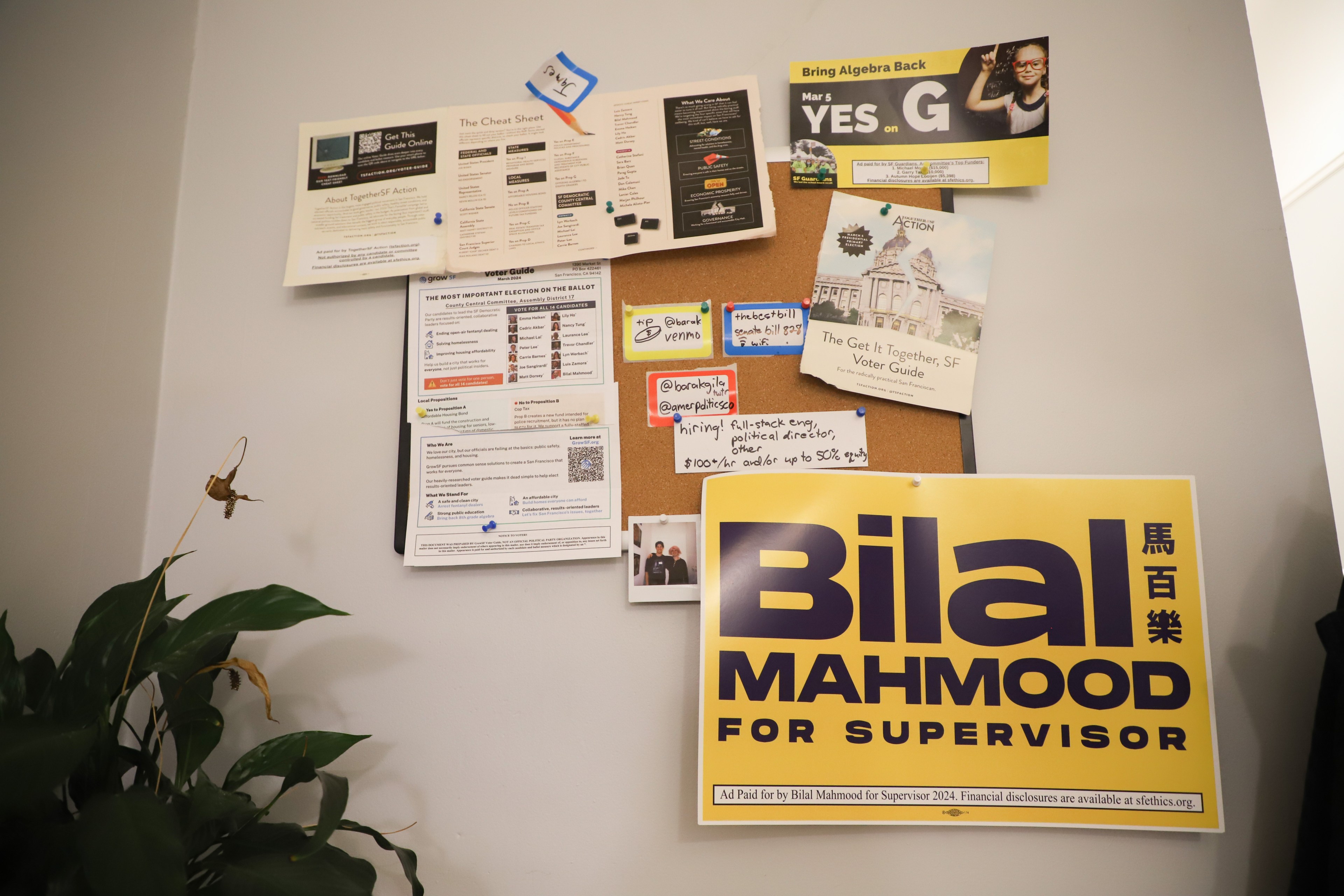
A bulletin board is covered with flyers, notes, and a political signs.
Political signs and other flyers hang on a corkboard at a political dinner party in a home in San Francisco. | Source:Christina Campodonico/The Standard

‘I could probably go to two house parties a week’

Tech entrepreneur and investor Asheesh Birla began throwing politically focused dinner parties in his Noe Valley home about three years ago. The goal was to give his friends in tech and medicine a forum to discuss their concerns about public safety and public education in the city. While Birla hasn’t thrown his own soiree since November, he has been surprised by the number of gatherings related to the DCCC race recently. 

“If you had told me before, there’d be like 50 dinner parties around this D-Triple-C, I’d say probably not. But it’s happening,” said Birla. “It’s like a niche election that I think folks are waking up to. It matters quite a bit. … I could probably go to two house parties a week at this point.” 

Two men in a room, one standing with papers, the other sitting and pointing, both look engaged in a discussion.
Gila speaks at a San Francisco political house party featuring Democratic County Central Committee candidate Mike Chen in the week ahead of the March 5 primary. | Source:Christina Campodonico/The Standard

One of the architects of these politically themed gatherings is Barak Gila, a 28-year-old passionate YIMBY activist and founder of the American Politics Company, a newly launched startup aiming to democratize the sale of political advertising. In the week leading up to this week’s primary, his company not only sponsored Manifold’s Taco Tuesday event with Chen, Gila also held his own freewheeling, fill-out-your-ballot dinner party at his Mission Dolores home.

Eccentric and intense, Gila has been tuned into local politics since the rise of the YIMBY movement while a student at UC Berkeley—even penning his own voter guides over the years. More recently, he decided to jump into SF politics full force, although he admits he was also motivated to promote his own company and ride a wave of tech money and influence pouring into local races.

“I’m not usually interested in just screaming into the wind. I want to scream into a current already almost there,” Gila said. “Back in 2018, I was too young and poor, and it was too early for tech to really win. You needed SF to get worse and tech money to get bigger and better and richer for all of this to come together. The winds are shifting in San Francisco.”

Now, almost like a tornado, Gila peppers his ballot party dinner guests with quiz-like questions over rib-eye and wine—“Who is paying for this political ad?” or “Does anyone know what a jungle primary is?” 

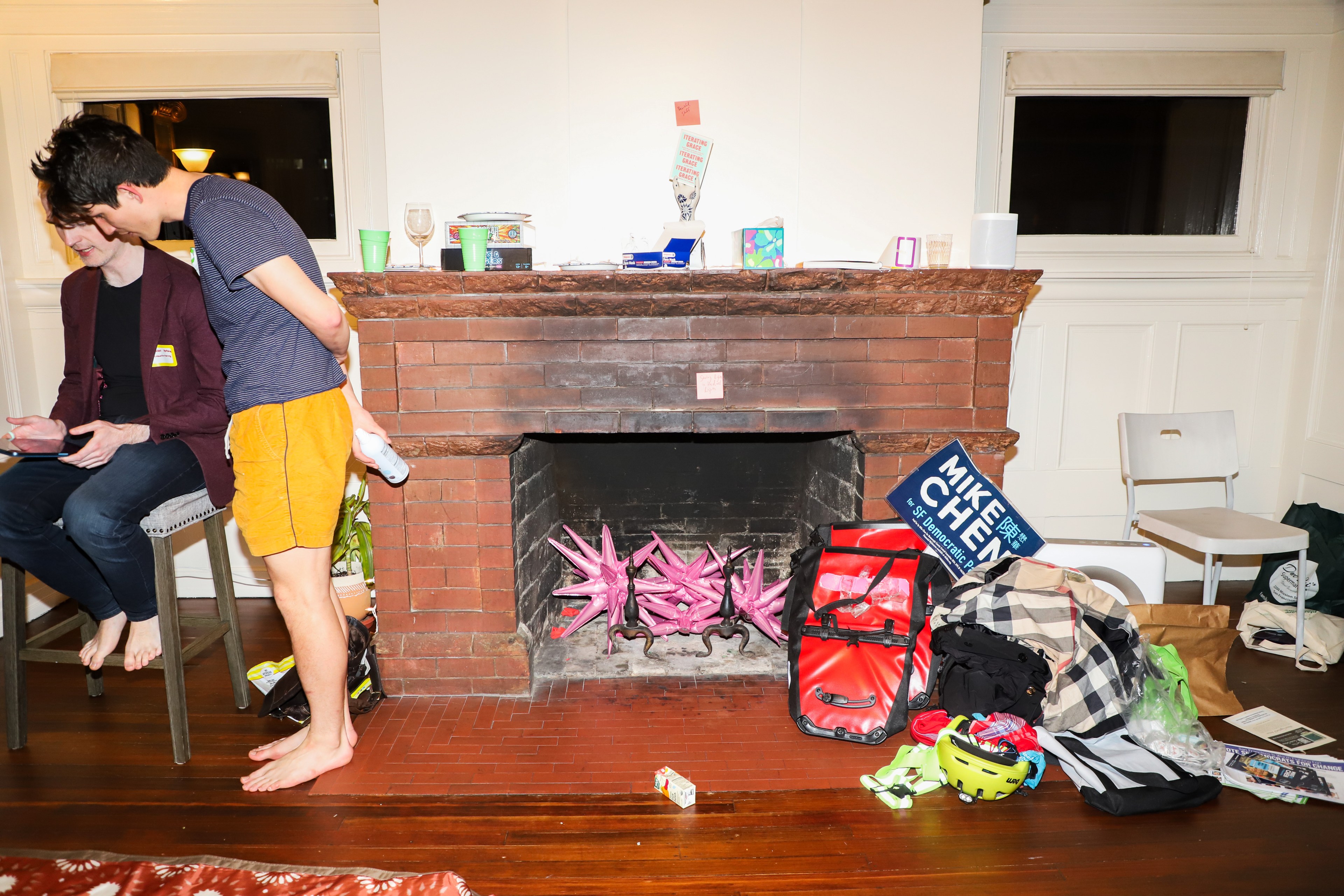
Scattered personal belongings and a Mike Chen campaign sign sit in front of a brink fireplace in a cluttered room with two individuals.
Party attendees hang out at the tail end of a political house party held in San Francisco for Democratic County Central Committee candidate Mike Chen. | Source:Christina Campodonico/The Standard

He also barnstorms events where he’s not the designated host or emcee. At a recent fireside chat held last Friday at the iconic hacker house, Mission Control, Gila grilled dual DCCC and District 9 supervisorial candidate Trevor Chandler and his fellow SF Democrats for Change DCCC slate-mate Michael Lai about what they would do to address the state mandate that San Francisco build 82,000 housing units over the next eight years

“What would you hold yourself accountable to?” Gila asked Chandler as soon as the floor opened for questions. “Like I, Trevor, I’m going to make sure we build at least X housing units via XYZ. Like, what is the top-level accountability on housing?” 

While Gila represented one of the more well-versed policy-wonk techies at that event, the gathering, which feted Chandler and Lai with pizza, flavored water and a crackling “fire” on a big screen TV, was geared more toward the Politics 101 crowd.

The image shows a flier with headshot photos and names of individuals running on the SF Democrats for Change slate for the Democratic County Central Committee.
An SF Democrats for Change slate flier sits on the floor of a political house party in San Francisco. | Source:Christina Campodonico/The Standard

Surabhi Todi, an aspiring founder and resident of Mission Control who runs the house’s TikTok account, said that her roommates decided to host Lai, specifically, both out of a sense of civic duty and techie solidarity. Lai’s credentials— which include directing North American and global outreach at the venture-backed university project Minerva, starting the micro-day care center network Tinycare and getting Garry Tan’s stamp of approval—were all appealing.  

“It’s important for us as founders and people who are kind of the tech elite of San Francisco to get really involved in SF politics,” Todi said. “We also think Michael represents the tech voice. … We trust Garry Tan and startup people.”

Lai also recently appeared as the guest of honor at the Commons, a social club beloved by the city’s Cerebral Valley set, and the intentional living community Noasis’ “Firepit Politics” happy hour. (Lai’s also a member of the Commons.) He said his visits to those spaces came organically, via invites from friends. “In humility, I’ve heard that people are really excited that I’m running and bringing a different perspective,” he said. But he also hoped those campaign stops could bridge a divide between San Francisco’s various communities, tech and otherwise.  

“I do want to provide representation for especially the young builder energy that has largely felt not engaged at all or represented in SF politics,” Lai said. “That’s how we unite the city.” 

As for party attendees, there were two main camps in attendance: the ones fed by a passion to get more involved with local politics and the ones just looking to get fed. 

A person reads a voter guide at a table where others are engaged in discussion, with food and drinks present.
UX designer Grace Ling reads a Grow SF voter guide during a ballot party at a San Francisco home. | Source:Christina Campodonico/The Standard

At Taco Tuesday, 26-year-old software engineer Richard Chen admitted to not being all that engaged in the political process. “I’m here as a function of the tacos,” he said. 

“It’s cool that it happened and that I’m at a random house party,” added software engineer Eliot Huang.   

As for Birla, he doesn’t see the hacker house political party trend ending anytime soon—it is, after all, an election year. 

“If we follow this trend post-March, it’s going to turn to supervisor races,” he said. 

“We were so proud of him.”

There’s a lot more animals in the lineup these days than dolphins, fish, and sharks. 

There’s The GoatFather, who brings his goats surfing. There’s surf comps just for dogs, and even a surfing pup who recently retired after a long and illustrious career.  

Then there’s there’s the surfing snakes and pigs. And now, there’s a surfing animal you’d least expect to find in the water, and it’s a surfing cat named Maverick, aka “Mavi” for short.

https://3814b903166c4e0862d861243ba3c01a.safeframe.googlesyndication.com/safeframe/1-0-40/html/container.html
https://imasdk.googleapis.com/js/core/bridge3.626.0_en.html#goog_1615094832

33 seconds of 0 secondsVolume 0%

Actve Streamhttps://www.youtube-nocookie.com/embed/__rw8EPknKo

On Sunday, The Dodo posted the video above and captioned it:

“Cat begs his dad to let him come surfing… and he’s so good at it, he demands to snowboard too!”

The video above tells Mavi’s story. His “parents” are Kayla and Nick, who take the cat just about everywhere with them. 

SPONSORED

Health Monitoring Litter

Cats are a mystery, but their health shouldn’t be. Monitor your cat’s health with Fresh Step’s pH-activated, color-changing litter.

BY FRESH STEP

READ MORE

And that means paddle boarding, hanging out in the pool, wake surfing, and good ol’ fashioned longboarding too. 

“Ever since he was little he was fascinated with all things water,” Kayla says in the video. It shows Mavi’s all around water skills, but focuses on the first time he actually went surfing. 

He walked the nose. Literally. 

Press play above to see what a waterman, or watercat, he is. 

Mavi also has his own Instagram with a recent post titled, “Water Training for Cats.”

SPONSORED

Health Monitoring Litter

Cats are a mystery, but their health shouldn’t be. Monitor your cat’s health with Fresh Step’s pH-activated, color-changing litter.

BY FRESH STEP

READ MORE

Here’s a few tips from the post. Click here for the rest. 

  • Once at the lake or river let your cat jump on and off the board, floaty or kayak.
  • BONUS TIP 1: We used to have a picnic right there on the shore so we could take hours introducing the board to our cats.
  • BONUS TIP 2: If you own the board/kayak, then you can even set it up in the house so you can train in advance and they can get acclimated to it.

How to Save Local Journalism with AI

Local journalism, once the vibrant heartbeat of communities, is facing a silent demise. A broader trend is emerging as local news outlets shutter across the country, contributing to the growing silence in what the Brookings Institution terms “news deserts” — counties lacking any local news coverage, leaving 65 million Americans in informational isolation.

The Urgency of Embracing AI: A Futuristic Approach

Unable to turn back time to when newspapers were omnipresent sources of community and public accountability, we must look to the future to revive the local news ecosystem. The solution lies in embracing the power of AI, especially at a time when local news faces financial challenges due to the shift of advertising online and the prevalence of free services from Big Tech.

A Call for Adoption in Journalism

With a global adoption rate of 35 percent, AI has become a ubiquitous force in various industries. ChatGPT, with over 100 million users in just two months, stands as one of the most rapidly adopted applications in history. Traditional news outlets, once late adopters of web publishing, must now avoid falling behind in this accelerated age of AI.

AI’s Influence Across Industries

Living in a world where AI influences much of the text and images we encounter daily, from autofill features in text messages to online shopping recommendations and virtual assistants like Siri and Alexa. Leading newsrooms globally, including The Washington Post and the BBC, are already tapping into AI’s potential through proprietary tools like ModBot, Heliograf, and Juicer.

AI’s Role in Local Journalism

For local journalism, AI holds the potential to be a game-changer, saving time and resources for newsroom reporters. As shrinking budgets force journalists into multitasking roles, AI can streamline their workload, freeing up more time for actual reporting. Tasks such as editable headlines, social copy, file formatting, SEO optimization, and post optimization for social media can be automated, allowing journalists to focus on content creation.

Unlocking Value for Local Journalism with AI

Beyond individual journalists, AI can revitalize the entire business of local journalism. Many publications have vast back-catalogs of content that remain untapped due to outdated formats. Large language models can read, analyze, and optimize this content, turning it into a valuable online resource and a potential source of advertising revenue.

However, the transformative power of AI can only be harnessed if newsrooms embrace it promptly. This pivotal moment offers the media industry a unique opportunity to shape how AI technology develops. Reflecting on the past, if print newspapers in the 1990s had influenced how web-based distribution would impact their business models, more newsrooms might have survived the digital transition with preserved institutional and local knowledge.

AI as the Lifeline for Local Journalism’s Survival

AI stands as a beacon of hope for the future of local journalism, offering efficiency, value, and a digital transformation. It’s not just about embracing new technology; it’s about securing the survival of a vital democratic institution — local journalism. The clock is ticking, and the adoption of AI might just be the key to saving what remains of the disappearing local news landscape. With AI, journalism can not only survive but thrive, creating a sustainable and vibrant future for local news outlets.

Hello world!

Welcome to WordPress. This is your first post. Edit or delete it, then start writing!